Put Your Cash In A Sate Of Flow

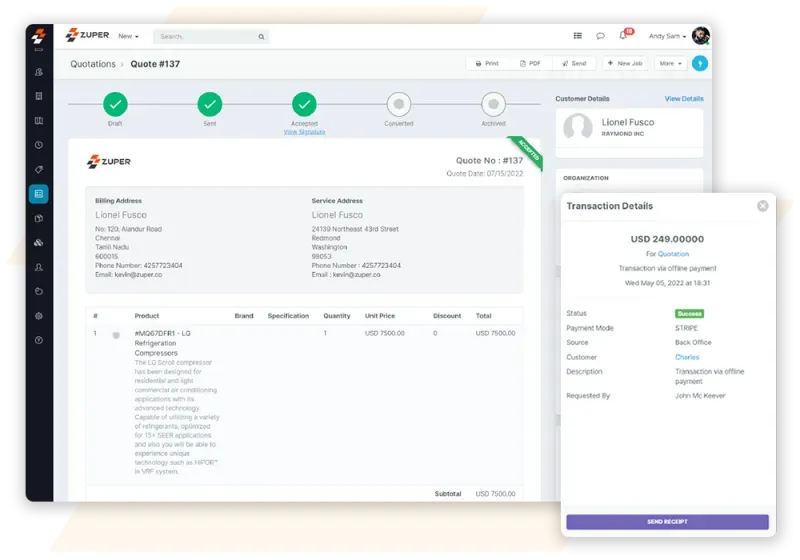
Automated accounting connects your front and back office, automatically creating estimates and invoices and processing payments to keep your cash flow and finances in check.

Automated accounting dashboard for field service businesses

Spend Less Time On Spreadsheets And More Time Moving Your Business Forward

Automate repetitive manual tasks, eliminate errors, save time and improve your team’s efficiency by auto-charging customers, collecting payments, and managing invoices that also sync with Stripe and QuickBooks.

Put Your Accounts Receivable On Auto-Pilot

Automate repetitive manual tasks, eliminate errors, save time and improve your team’s efficiency by auto-charging customers, collecting payments, and managing invoices that also sync with Stripe and QuickBooks.

  • Quickly generate and deliver branded invoices with payment links.
  • Save customer credit card information, set up automated payments and late fees, and offer financing plans.
  • Automate payment reminders with personalized communications across email, mail, phone, and SMS.
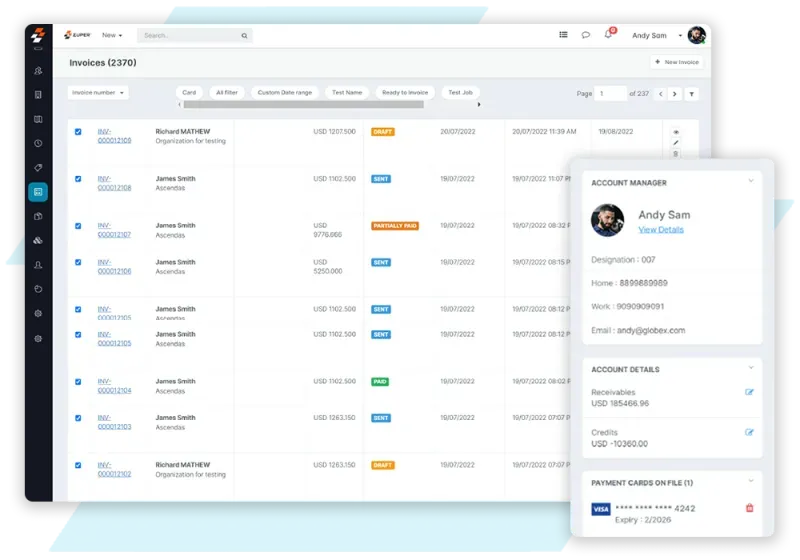
Automated invoice generation for field service jobs
Digital payment collection and reconciliation in field service

Improve Your Field Agent's Productivity

Save time and put the power of estimating in your field technician’s hands enabling on-the-job quotes or automated job quotes from the back office that are accessible by the field tech on-site.

  • Send digital estimates, convert them into invoices, and collect deposits with just a few clicks.
  • Auto-generate invoices on job completion and drill down into line items for full transparency.
  • Make it easier for customers to pay with credit cards, direct debit / ACH, PayPal, and more, improving collection success rates and user experience.

Effortlessly Collaborate As A Team

Deliver better experiences with smart workflow tools that make it easy to share customer and invoice data, customer notes, estimates, and communications – in a unified workspace.

  • Total payment visibility and faster reconciliations
  • No wasted time chasing pending payments
  • Built to integrate with ERPs and accounting systems
  • Increase speed of invoice generation without the involvement of technicians' time
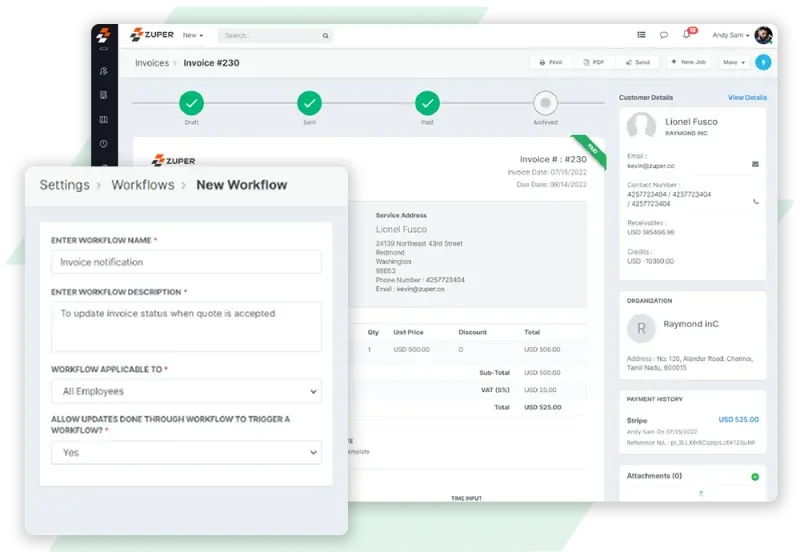
Job costing and financial reporting for field service businesses

Fast-Growing Service Organizations Love Zuper!

stpaulKArcherSaltPayVISail InternetPro VigilAugustaTeya

Learn More About Zuper Today

Frequently Asked Questions

Field service businesses can track and manage inventory across multiple locations by creating individual storage locations in Zuper. Users can pre-define storage locations for parts/services under the “Settings” module so that locations are available to be selected when new parts/services are added.
Zuper offers multiple options to manage products in bulk. Stakeholders can either create inward transactions using a spreadsheet or CSV file and upload products seamlessly or choose to connect with a third-party tool like Zoho Inventory and sync all stock information easily. The bulk select option in Zuper Web App allows field service businesses to select and edit or delete products in bulk.
Yes, administrators and back-office managers can add or remove a part/service from a storage location. Once the storage location is enabled using the “Settings” module, stakeholders can select that location when they add a new part/service. Similarly, when a part/service is edited, there will be an option to edit or remove the storage location.
Field service management businesses can manage their inventory processes effectively with an inventory management system. An ideal inventory management tool will not only help FSM businesses ensure upcoming jobs run smoothly but also prevent any service delays by identifying and resolving inventory shortages before they even occur.
Inventory management software focuses on tracking the quantity, location, and levels of inventory proactively to trigger replenishments as and when required. Whereas, other supply chain software focus on purchasing and procurement of items to facilitate day-to-day operations.
Inventory management can be classified into four types based on the inventory managed, namely, raw materials, works-in-progress, finished goods, and maintenance, repair, and operations (MRO).