

Drawing from BuildOps’ 2025 survey of 606 contractors, Salesforce’s 7th Edition State of Service report covering 6,500 service professionals (published 2025), and Zuper’s State of AI in Field Service research analyzing 100 field service leaders, this report examines where AI impact on roofing operations creates quantifiable improvements: dispatch optimization, automated documentation, job summaries, scheduling efficiency, and customer communication.
Based on field service productivity analysis across these five areas, AI can recover up to 2.3 hours per technician per day, transforming wasted time into billable capacity without adding headcount or trucks.
The Productivity Gap: Where Your Technicians Lose 3.4 Hours Daily
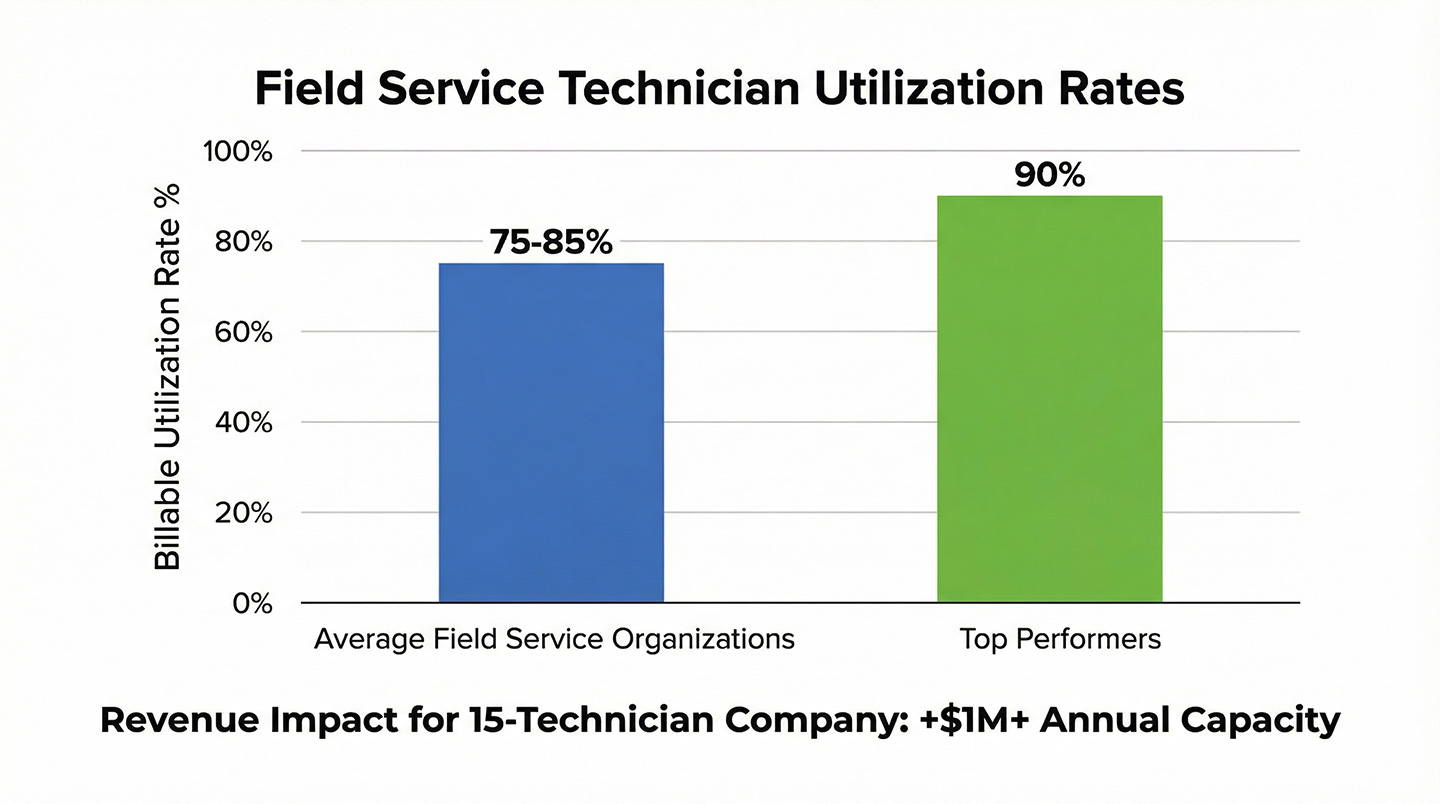
Your roofing technicians work 9-hour days, but how much of that time is actually billable? According to the Technology Services Industry Association (TSIA), most field service organizations achieve only 75% to 85% billable utilization, while top performers reach approximately 90%. Aberdeen Group research identifies what consumes the gap: drive time between jobs, parts-related delays and return trips, paperwork and administrative tasks, schedule gaps and idle time, and searching for information or calling the office.
Aberdeen’s benchmark data shows that companies with optimized scheduling increased the number of work orders completed per technician by 20%, increased billable “wrench time” by 18%, and improved service contract compliance by 25%.
For a 15-technician roofing company billing at $200/hour, improving from 75% to 90% utilization through AI-powered optimization translates to over $1 million in additional annual revenue capacity without extending work hours or hiring additional staff.
Five Ways AI Recovers Wasted Time
1. AI Dispatch: Cut Drive Time in Half
Human dispatchers assign jobs using simple rules: the nearest tech, or whoever handles that work type. AI evaluates 15+ variables at once:
- GPS location and real-time traffic
- Skill requirements and job duration
- Parts inventory on trucks
- Optimal sequencing to minimize total fleet drive time
Aberdeen Group research shows that companies with AI-optimized scheduling increased the number of work orders completed per technician by 20%. For a 15-tech roofing fleet completing 60 jobs daily, that’s 12 additional jobs, representing significant revenue capacity.
Zuper’s AI dispatching uses real-time data and adaptive scheduling algorithms to dynamically optimize routes, automatically reassigning jobs as conditions change throughout the day. Zuper’s research shows 84% of field service organizations are using or planning to implement AI in scheduling and dispatching within 12 months, representing the highest adoption rate across all AI applications.
2. Documentation: From 30 Minutes to 3 Minutes
Field paperwork, including work orders, inspection reports, parts used, time tracking, and photos, consumes valuable technician time daily. Aberdeen Group research found that companies deploying mobile documentation tools increased billable wrench time by 18%.
Zuper’s AI Voice Notes let techs document jobs hands-free while working. Technicians simply speak their updates, and AI automatically transcribes, organizes, and converts speech to structured data. Take 3-5 photos, record a voice summary, and AI generates a complete work order. Across a 15-tech fleet, an 18% improvement in wrench time adds the equivalent of nearly three full technician workdays of capacity each day.
3. Job Summaries: End the Office Info Hunt
AI job summary tools instantly assemble notes, photos, GPS data, parts used, and timestamps into structured recaps for every visit. Office teams and production managers stay aligned without manual compilation or follow-up calls. Maven Roofing, a Zuper customer, reported saving 8 hours per person weekly after implementing AI job summaries alongside other automation. Office staff no longer call techs to clarify handwritten notes or reconstruct job timelines from fragments. Zuper’s field service research found that 56% of organizations say AI has improved operational effectiveness, while 68% report improved customer satisfaction, which are benefits that flow directly from better information visibility across teams.
4. Parts Management: Improving First-Time Fix Rates
Return trips for parts are expensive hidden costs. A tech arrives, discovers they lack the required part, and faces a 30-60-minute round-trip to the warehouse or distributor. Aberdeen Group research found that companies deploying work-order optimization and mobile field service solutions achieved a 11% increase in first-call resolution rates.
AI inventory agents analyze each tech’s upcoming schedule, equipment types they’ll service, and historical failure patterns to recommend optimized truck loadouts, reducing parts-related delays. For roofing operations handling emergency repairs and storm damage, improved first-call resolution directly impacts same-day close rates and customer satisfaction scores.
5. Customer Communication: Always-On Responsiveness
Salesforce’s research found that 85% of field service leaders plan to increase AI investments over the next year. AI’s impact on roofing operations extends beyond field efficiency to customer experience, with AI responders handling after-hours inquiries, appointment confirmations, service updates, and rescheduling.
For roofing companies, this matters during storm seasons when call volumes surge significantly. AI responders field initial storm-damage inquiries, collect property information and photos via automated workflows, and schedule inspections, all while human staff focus on complex insurance coordination. Salesforce data shows that 30% of service cases are currently handled by AI in 2025, projected to reach 50% by 2027, demonstrating the rapid adoption of AI in customer service operations.
The Compound Effect: Why Multiple AI Agents Win
Deploying a single AI agent delivers solid but limited results. The productivity explosion happens when multiple AI agents work as an integrated system.
How it works: When AI dispatches a tech to fill a scheduling gap, AI inventory has already ensured the truck has the necessary parts, and AI documentation automatically generates the completed work order.
The result: Aberdeen Group research found that companies deploying comprehensive optimization across scheduling, routing, and mobile tools achieved 28% increases in work orders completed per technician per day, demonstrating the compound multiplier effect of integrated systems.
Maven Roofing achieved a 20% improvement in same-day close rates after deploying Zuper’s AI-native platform, which includes AI dispatching, automated job summaries, voice documentation, and Zuper Glass for hands-free inspections. The integrated approach addresses all friction points simultaneously rather than solving problems in isolation. Zuper’s research confirms this trend: 79% of field service organizations report satisfaction with their AI implementations, and 74% plan to increase AI investments over the next 12 months.
Where AI Delivers the Biggest Wins in Roofing
Field service organizations that systematically implement AI across dispatch optimization, automated documentation, predictive parts management, schedule gap filling, and instant job summaries recover significant productive capacity per technician per day.
AI-native platforms like Zuper position roofing companies to capture these gains through integrated dispatch, documentation, inventory, and communication tools that work as a connected system. AI impact on roofing operations creates a competitive advantage for companies that act now to close the utilization gap between average performers (75-85%) and top performers (90%+). For a 15-person roofing fleet, reaching top-performer utilization levels unlocks over $1 million in annual revenue capacity that is currently lost to drive time, paperwork, and scheduling gaps.
Discover how Zuper’s AI-native roofing platform transforms operations from inspection to invoice, or schedule a demo to see AI dispatching, voice notes, automated job summaries, and hands-free documentation in action.