

Today we shipped Zuper Sense. I’ve been building software for decades but have never been more excited than this.
For the folks who’ve been with us since the early days, you know what this means. For the roofers who’ve been quietly testing it inside their businesses for the past few months, you’ve already lived it. For everyone else, pull up a chair. I want to walk you through what this is, why we built it, and what changes for you.
The Quick Version
Zuper Sense is the intelligent command center that sits on top of your trades business. It connects every job, every invoice, every crew, every dollar across your operation. You can ask it anything in plain English, the way you’d ask your office manager. It’ll tell you what’s at risk, what’s coming, and what to do about it. When you’re ready to act, it deploys an AI agent to handle the work for you. Around the clock. While you’re on a roof, on the phone with an adjuster, or asleep.
That’s the one minute version. Now let me tell you why it exists.
The Frankenstein Problem
If you run a trades business, I don’t need to describe the chaos. You’re living it.
Five tools to do one job. One tool for leads. Another for measurements. A third for photos. A fourth for supplements. A fifth for the books. An answering service for the phones when a storm rolls through. And a spreadsheet (sometimes three) trying to make sense of all of it on Friday afternoon.
We’ve got a name for this internally. We call it the Frankenstein problem. It works. Sort of. But by the time you find the problem, it’s already cost you the job.
I’ve heard the same sentence from owners in Texas, Colorado, Florida, and the Carolinas. Different markets, different scale, same gripe: “I’ve got all the data. What I don’t have is something watching it for me.”
That sentence is what built Zuper Sense.
The conversation that changed everything
There’s one specific moment I want to share with you.
I was sitting with a multi-location roofing owner. He’d just lost a $40K estimate. The lead came in during a hailstorm. His office was buried, his phones never stopped ringing for three days straight, and the follow-up just never happened. He found out three weeks later. The homeowner had already signed with a competitor down the road.
He looked at me, kind of deflated, and said: “We had everything we needed to win that job. The data was right there in your platform. Why didn’t your system tell me?”
I didn’t have a good answer.
We had reports. We had dashboards. We had alerts. He had access to all of it. But none of it was actually watching the business. None of it was running ahead of his next problem. We’d built him a beautiful filing cabinet when what he needed was a chief of staff.
That conversation broke something open for me. I went back to the team and said it out loud for the first time: we are not a system of record anymore. We are a system of work. The operator should not be operating. The operator should be supervising. Every decision we make from here forward has to serve that shift.
That is the line everything else in this post hangs on. So let me say it one more way, plainly. For twenty years, software for the trades has been a place to put information in and go looking for it later, usually too late. Zuper Sense is the opposite. It runs the business alongside you, deploys an AI agent the moment something needs to move, and reports back when the work is done. You stop hunting for answers. The answers find you.
Before Zuper Sense, and After.
Picture your Monday morning before Zuper Sense. Open the CRM. Pull a report on overdue invoices. Export to Excel. Sort by aging. Try to figure out who to call first. Email the list to your office manager. Hope she’s got time. Move on to the next fire.
That whole exercise? Maybe two hours. Maybe more. And by the time it’s done, three more things have already gone sideways somewhere else.
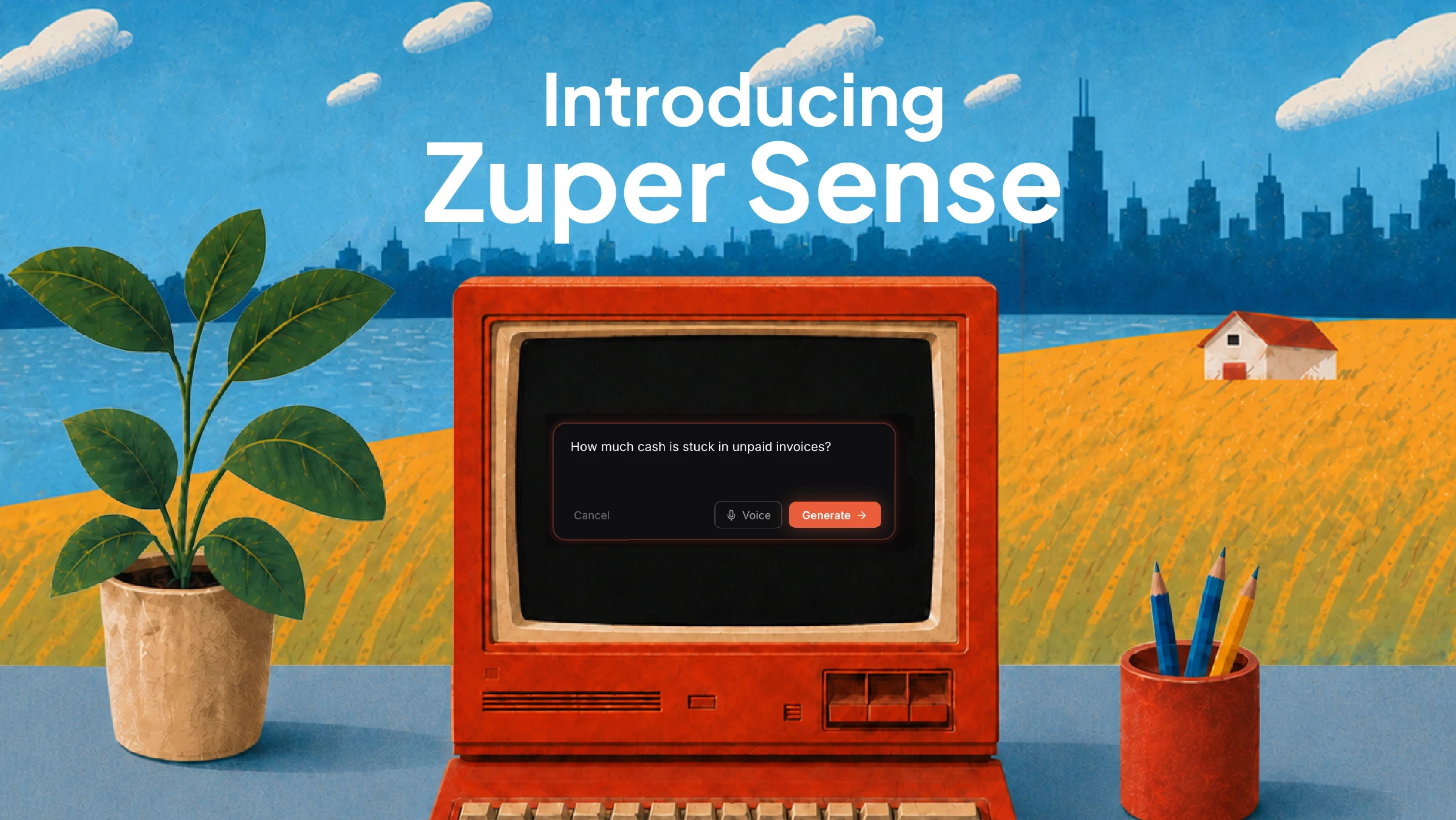
Now picture it with Zuper Sense. You type one question. “What’s at risk in collections this week?” Zuper Sense pulls the data. Calculates DSO against industry benchmarks. Surfaces the at-risk accounts. Tells you what those invoices will cost you if nobody acts in 14 days. And gives you a single button that deploys an AI agent to start working those accounts immediately. Around the clock. Until the money comes in.
You stop operating. You start supervising.
What Zuper Sense Delivers
- Plain-English questions. Type what you want to know the way you’d ask a teammate. Zuper Sense handles the rest. No SQL, no report builder, no analyst on speed dial.
- Real-time eyes on the business. Zuper Sense doesn’t wait for you to ask. It’s watching jobs, invoices, crews, and carriers around the clock. When something starts to slip, you know.
- Predictions in dollars. Every signal Zuper Sense surfaces comes with a number attached. Not “you might want to look at this.” More like “this is going to cost you $40K if nobody acts in 14 days.”
- One-click agents. When you spot a problem, you can deploy an AI agent to fix it without leaving the screen. Agents call accounts. Follow up on estimates. Run dispatch optimization. While you’re doing the rest of your job.
- Live on day one. No data migration, no IT project, no six-month software rollout. Turn it on and you’re getting answers in minutes. We’ve had customers find value the same afternoon.
Beyond Your Four Walls: Intelligence Packages
Here’s the thing. Your business doesn’t operate in a vacuum. Storms reshape your week. A competitor’s reputation slipping is your opportunity to capture. Permit filings tell you who’s planning what in your territory before anyone else knows.
Zuper Sense pulls all of that in too, through Intelligence Packages. They’re add-on layers that plug Sense into external data signals and proactively alert you when something in your market changes.
The launch lineup:
- Storm Intel. National Weather Service, NOAA, and predictive weather data combined with your crew capacity and territory. Sense surfaces a projected storm pipeline and a pre-staged response across CSR Agent, Marketing Agent, and Dispatch Agent before the first hailstone hits.
- Reputation Intel. Tracks your reviews and, more importantly, your competitors’ reviews in your zip codes. When their rating slips, Sense flags the opening and recommends a Marketing Agent campaign to capture the homeowners who would have called them.
- Permit Intel. Aggregates permit data across thousands of municipal databases, cross-referenced with storm history and roof age. Sense identifies aging-roof properties that experienced storms but never filed a replacement permit. It’s the highest-intent prospecting list in the trade.
Carrier Intel and Market Intel are next, with more packages on the way.
What Our Beta Customers Are Telling Us
We’ve had Zuper Sense live with Maven, Russell Roofing, A&A Roofing, and Marasun for several months now. Their feedback has shaped the product in ways I honestly didn’t see coming.
JT Ulyatt, CEO at Maven, put it this way:
“For most of my career, the roofing industry has run on reports we read after the fact. Zuper Sense is the first tool I have used that actually runs ahead of an operator. I am not waiting on a Friday spreadsheet to find out what happened Monday. I am seeing it as it happens with a fix already lined up. That is the biggest change I have made to my business in the past twenty years.”
Across the beta cohort: $50K to $150K a month recovered from estimates that would have aged out. DSO down 30 to 45 days. 100 percent storm-event call answer rates, capturing $200K to $500K in qualified pipeline per event. A 20 to 35 percent lift among sales reps who’d been underperforming.
These are not pilot stats from a controlled environment. Real businesses. Real season. Real money.
The Bigger Picture
Zuper Sense is one piece of something larger. We are building the AI Operating System for the exterior trades, and the whole point of that system is to flip the operator out of the operating seat and into the supervisor seat.
Zuper Sense is the brain. It watches the business, finds the problems, and decides what needs to happen next.
Zuper Glass, the smart eyewear we launched last year, is the eyes. It goes on your crew’s head and puts AI directly on the roof.
Nova, our AI CSR Agent, is the voice. She answers every inbound call, qualifies the lead, and books the inspection without anyone in your office picking up.
And our growing roster of AI agents (CSR, Field, Marketing, Dispatch, Sales Coach, with more on the way) is the hands. They do the work behind every recommendation Sense surfaces.
A signal captured on the roof flows straight into the next decision in the office. AI does the work in between. No translation step. No logging into four different things to get one answer. One system, one source of truth, one place where the work actually happens.
That is what a system of work looks like.
Zuper Listens – How We Figure Out Whats Next
Look, I’ll be honest with you. Zuper Sense is shipping today, but we’re learning alongside our customers. Our agent roster is going to grow over the next year. And we’re leaning heavily on what you tell us to shape what comes next.
One of our beta customers gave us a phrase we use internally now: Zuper Listens. They started saying it because their previous platforms made them wait six months for a response to feedback. With us, they were seeing changes ship back within weeks. We earned that phrase. We intend to keep earning it.
If you try Zuper Sense and something doesn’t work the way you expect, tell us. If you wish it did something it doesn’t yet do, tell us that too. The roofers who’ve been building this product alongside us are part of the reason it works. We need more of them.
Already a Zuper for Roofing customer? Zuper Sense is live in your platform right now. Log in and ask it something. (If you don’t see it, check in with your Zuper representative).
Not yet a Zuper customer? You can request a demo here.
The trades have been waiting for software that runs ahead of the business instead of behind it. The system of record era is over. The system of work era starts today. We’re proud to be the first ones to ship it.