

You’re walking a ridge after a hail event: dings on the flashing, cracked caulk around the vent stack, granule loss across the entire north face. You know exactly what you’re looking at. Getting it into the job record means either stopping to pull out your phone and type it up, or trusting that you’ll remember the details when you’re back in the truck 45 minutes later.
That gap between what your crew sees on the roof and what your office actually receives is where estimates stall, adjuster timelines slip, and rework starts. The best tech for roofing contractors in 2026 isn’t solving that with more apps or better forms. It’s solving it by making documentation happen in real time, without pulling anyone off the work.
This article covers where roofing technology now stands and what hands-free, voice-activated field tools make possible on every job.
The Evolution of Tech for Roofing Contractors
| Era | Primary Tools | What It Solved | Where It Fell Short |
|---|---|---|---|
| Paper-based (pre-2010) | Clipboards, handwritten notes, physical folders | Basic record-keeping on-site | No field-to-office sync; notes got lost; errors compounded |
| Early digital (2010–2016) | Spreadsheets, email, basic CRM | Digital storage, pipeline tracking | Manual re-entry across disconnected tools; no mobile access |
| Mobile app era (2016–2022) | Job management apps, photo tools, estimate platforms | Field mobility; faster estimates from the truck | Still required hands-on device use; documentation interrupted the work |
| Integrated platforms (2022–2024) | All-in-one CRM/FSM with scheduling, dispatch, invoicing | Unified job lifecycle; eliminated double entry | Documentation stayed manual; field teams still had to stop and type |
| Voice and AI field tools (2025–present) | Voice notes, smart glasses, intelligent dispatch | Hands-free capture; real-time sync; automated documentation | — |
Zuper Glass: The Tool That Disappears Into the Work
Mobile apps were a step forward. Crews could take photos from the truck and send estimates before leaving the driveway. But documentation still meant stopping: gloves off, phone out, app open, repeat. Notes typed after hours or reconstructed from memory added friction to already demanding work.
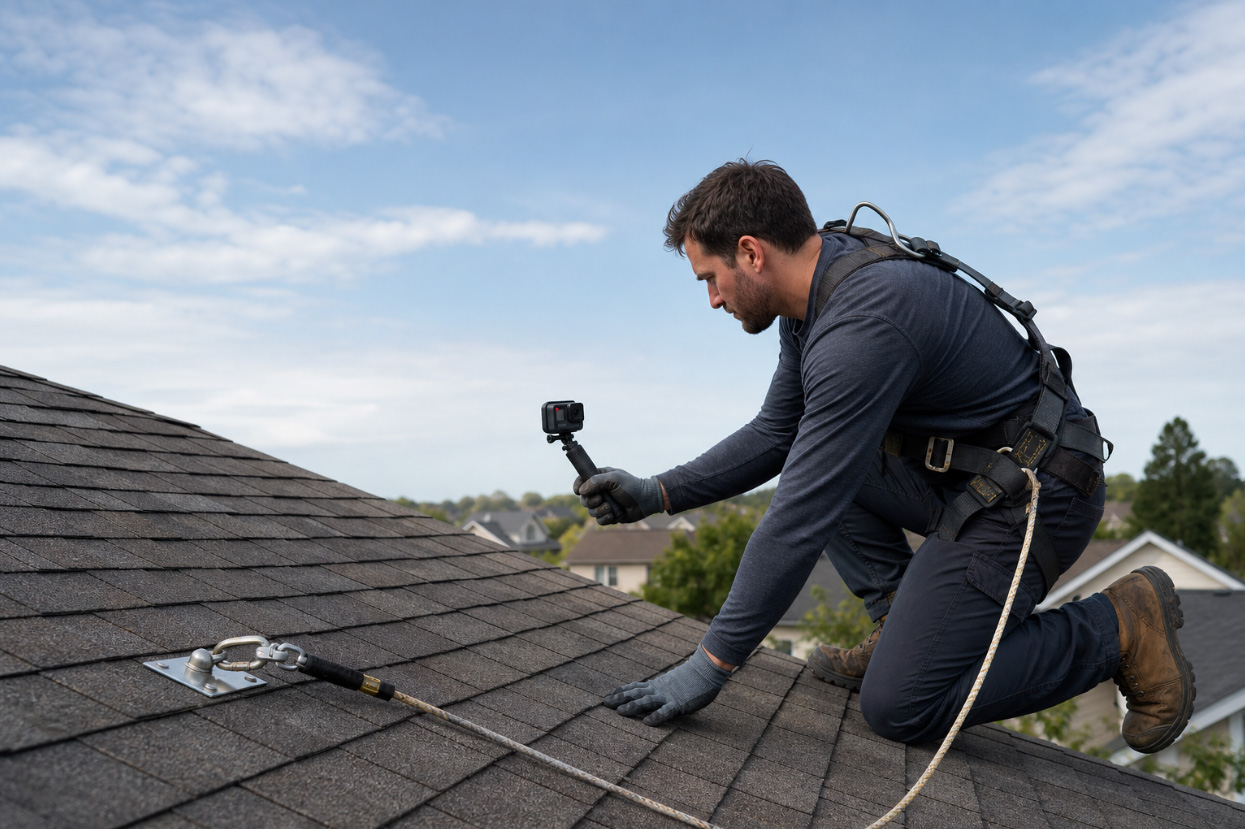
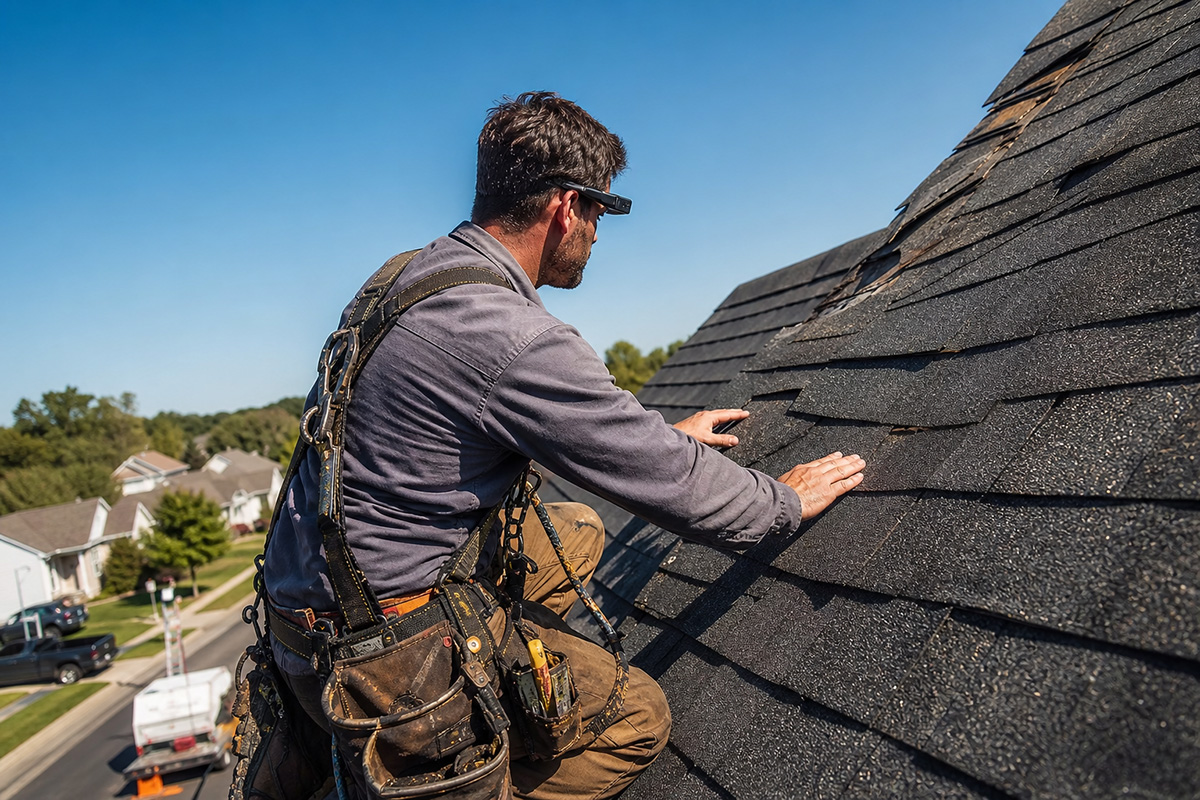
Built specifically for field teams, including roofers on steep pitches, in attics, and around vent stacks in summer heat, Zuper Glass uses AI to capture what you see and say, hands-free. You pair the glasses to Zuper on your phone, open the job, and start capturing with your voice and a tap. Photos, video clips, and voice notes sync into the job record without your hands leaving the work.
Say “lifted flashing at the northeast hip, recommend full replacement, estimate 14 linear feet.” Zuper Glass captures it as a voice note. The AI cleans up the transcription and attaches it to the job record. Your office sees it before you’ve moved to the next section of the roof.
The glasses weigh 1.5 ounces and fit under most hard hats. Dual microphones cut jobsite noise so voice commands register clearly. The 8-hour battery covers a full shift, and 4GB of onboard storage holds up to 10,000 photos for inspections that run out of cell range, all syncing automatically when you reconnect.
To see the full product breakdown, the Zuper Glass page covers how it’s built and how it connects to the platform.
Tech for Roofing Contractors: What Hands-Free Actually Looks Like
Good roofing tech works in the conditions roofers actually deal with: heat, wind, slope, gloves on, two hands occupied, and a cell signal that cuts out mid-inspection. Here’s what Zuper Glass handles on the roof:
- Photo capture without stopping. A tap on the frame triggers the camera while you’re looking directly at the damage. The photo syncs to the open job. No phone pulled from your pocket, no pause in your inspection.
- Damage notes recorded as you go. “Hail impact on south-facing field, three-tab shingles, approximately 14 impacts per 100 square feet, recommend full replacement.” That observation syncs into the job record as a voice note. The AI cleans up the transcription so it reads clearly for the adjuster. You didn’t type a word.
- Checklist and inspection fields filled by voice. Zuper’s AI Voice Notes lets you speak directly into any checklist or inspection form field instead of typing. Your answer is transcribed, cleaned up, and saved to that field. No manual entry at any point in the inspection.
- Communication without climbing down. You’re at the peak, you find something unexpected. You describe it out loud, it’s in the job record in real time (as soon as you have signal), and your office can respond without interrupting the inspection.
- Consistent documentation across every crew member. The lead on your busiest crew documents at the same quality as your most experienced inspector because the system does the capturing, not individual recall or typing speed.
- Safer focus on the work. No fumbling for a phone on a steep pitch. No split attention between the surface you’re walking and a screen in your hand. Both hands stay on the task, and documentation happens without the distraction that turns a routine observation into a hazard.
| Task | Without Zuper Glass | With Zuper Glass |
|---|---|---|
| Photographing damage | Stop work, pull phone from pocket, open app, take photo | Tap the frame; keep moving |
| Recording damage notes | Type after the inspection or reconstruct from memory | Say it out loud; AI transcribes and syncs it to the job record as soon as you have signal |
| Completing an inspection checklist | Manual entry on phone or tablet after each observation | Speak into any checklist field; AI Voice Notes transcribes and saves the answer |
| Communicating with the office from the roof | Climb down or call; inspection stops | Describe it out loud; it’s in the job record in real time |
| Documenting consistently across all crew members | Varies by individual recall and typing speed | Your crew documents consistently on every job, regardless of who’s on the roof |
Why Real-Time Documentation Changes Storm Season
A hailstorm cuts through on a Thursday afternoon. By Friday morning, your phones are ringing from homeowners across four neighborhoods. Two adjusters won’t schedule their site visits until they have documentation in hand. And 30 new leads are sitting in the queue while 10 jobs are already mid-production.
Every hour without organized documentation is an hour the adjuster waits, the supplement stalls, or the homeowner calls for an update that no one has time to give. The inspection is the anchor for everything downstream: the estimate, the claim, the supplement pull, and the customer conversation.
When your crew completes an inspection using Zuper Glass, the documentation syncs as soon as connectivity returns, often before they’re back at the truck. Photos are tagged to the right job. Voice notes are transcribed and ready to share. Three things happen that used to take until the next morning:
- The office has an organized record of every observation captured during the inspection, before the crew’s back at the truck.
- Your office can pull a timestamped, photo-tagged package from the job record without calling the crew for follow-up details.
- Your crew doesn’t make a second trip because someone needed more detail on something that wasn’t captured the first time.
Adjusters move faster when the documentation arrives organized. Supplement pulls are cleaner when photos are tied to specific roof locations with field notes already written. Maven Roofing saved 8 hours per person per week and lifted their same-day close rate by 20% after consolidating their operations onto Zuper.
How the Field Connects to the Full Operation
The real value of what your crew captures with Zuper Glass is where it lands.
Everything documented in the field syncs into the Zuper platform: the same place your dispatch board, job schedule, customer records, and invoicing already live. The photo your lead roofer took at 10 AM is in the job record when your coordinator checks at 11. Zuper built the glasses to work with the platform, not alongside it. There’s no separate system to import from and no manual upload step.
For the roofer, that means finishing a job with the documentation already done. No write-up in the truck. No calling the office to fill in what you couldn’t type fast enough on the roof. You’re ready for the next job before you’ve backed out of the driveway.
The rest of the operation moves the same way. Here’s what runs automatically once a crew is in the field with Zuper Glass:
- Photos captured via tap sync to the open job record, visible to the office in real time.
- Voice notes are transcribed, formatted, and added to job documentation without manual entry.
- Completed inspection checklists sync to the job record and trigger the next workflow step.
- Dispatch Assistant reads crew location, skill, and job complexity to shortlist the right person for each job, so the assignment takes seconds instead of a coordinator working through a call list.
- After hours, Zuper’s CSR Agent captures inbound storm leads, books inspections, and queues them for morning dispatch automatically.
During a December 2025 storm event, A&A Roofing captured $440K in qualified deal value while their crews stayed in the field and their office stayed dark.
For a closer look at how AI fits the full job lifecycle, Zuper’s guide to the best AI roofing CRM software covers what to evaluate from lead intake to invoice. For storm-season operations, the guide to roofing CRMs for storm restoration covers how dispatch, documentation, and after-hours lead handling connect when volume spikes.
What This Means for the Crew on the Roof
The best tech for roofing contractors lives on the roof, in the flow of the work, and it runs without asking your crew to stop.
Zuper Glass is what that looks like in practice: the inspection done and documented before you’re off the ladder. Photos tagged. Voice notes clean and ready. No write-up session in the truck, no reconstructing details from memory, no calling the office to fill in what you forgot.
If you’re ready to see how hands-free field technology cuts admin time and improves what your crew delivers on every job, request a Zuper demo and see Zuper Glass in action.