

Your field lead finishes a roof inspection, records photos and notes on a phone, and then re-enters the same details into the office system from the truck. The address, damage notes, and material needs all get entered twice before the job can move forward.
That kind of duplicate entry is exactly why roofing tech trends are moving toward AI, connected field operations, smarter documentation, and workflow automation. The 2026 AGC and Sage Construction Hiring and Business Outlook survey shows that commercial construction firms are already applying AI across their daily operations. The next section breaks down where that adoption is taking hold.
What the 2026 Data Says About Roofing Tech Trends
The AGC and Sage survey covered 951 AGC member firms. Their work leans toward data centers, power, healthcare, and infrastructure, so the results represent commercial construction rather than residential roofing.
The same AI tasks still apply to roofing operations: office administration maps to lead and job management; estimating maps to proposals and supplements; design and preconstruction maps to project planning; and recruitment or training maps to crew development.
The report found that 61% of commercial construction firms use AI or plan to increase AI investment. It also identified four reported AI use categories:
- Office and administrative functions: 45%
- Estimating: 23%
- Design or preconstruction: 20%
- Recruitment, training, or other HR functions: 16%
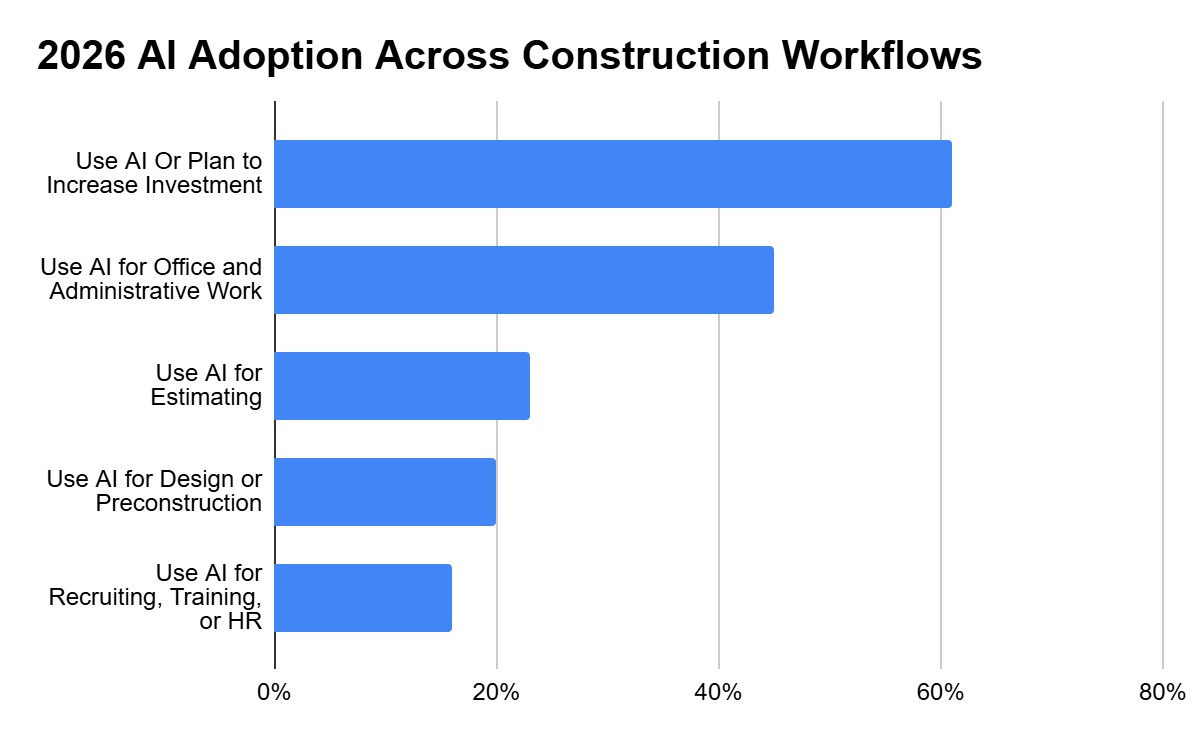
These figures show where construction companies are putting AI to work. Roofing contractors can apply the same pattern to lead intake, inspection records, estimating, production planning, and crew development.
AI Is Moving Into the Work Between Roof Visits
AI becomes useful when it handles a repeated task during the workday. For your roofer, that task is typing an inspection summary after climbing down from a roof. For your dispatcher, it’s finding the right crew after a weather delay. For your coordinator, it’s answering the same appointment questions throughout the day.
Construction firms are already applying AI to office work, estimating, design, preconstruction, and recruitment and training. Roofing teams can apply the same pattern to field documentation. A voice note recorded during an inspection gives your estimator the facts needed for a proposal. A structured job summary helps your production manager review progress without calling the crew.
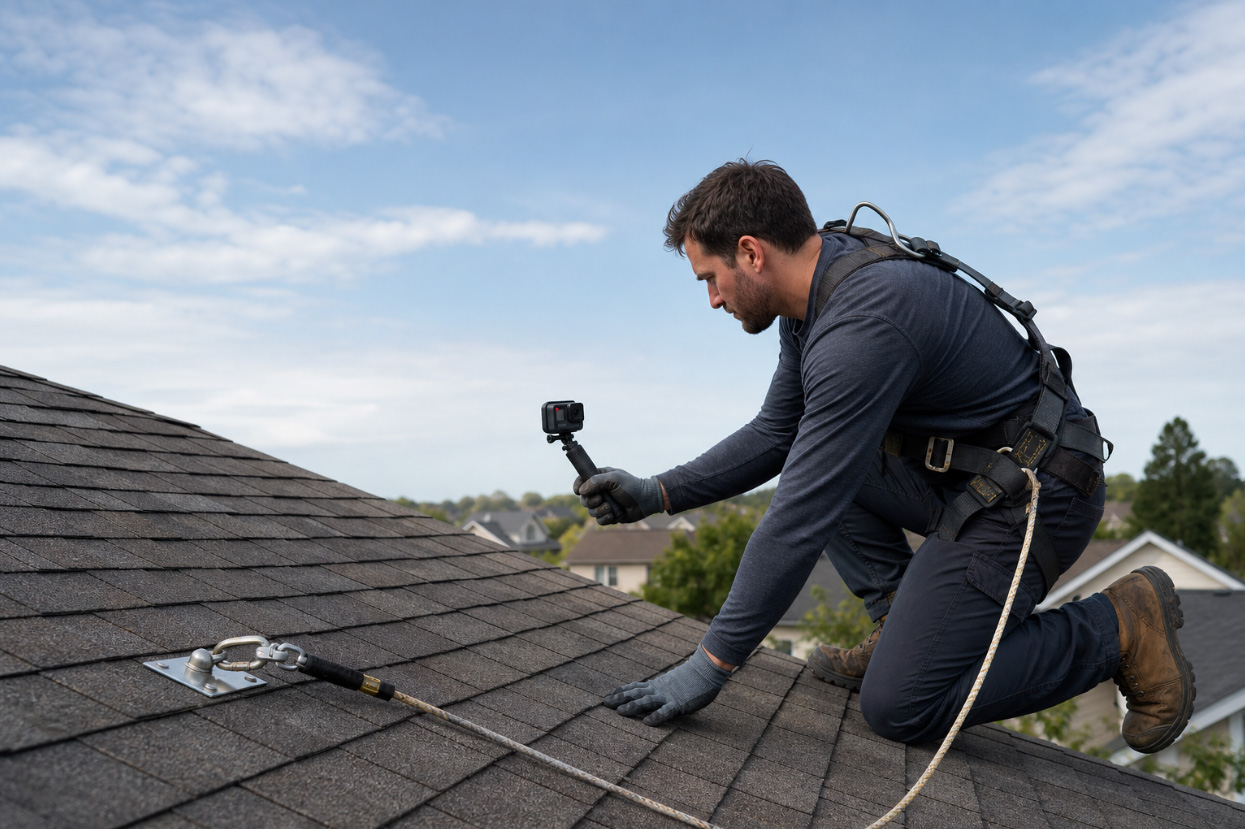
Zuper’s Field Agent illustrates how this trend is reaching the roof. A crew member speaks and records video while working, captures photos, and turns a walkthrough into a structured job record.
The AI roofing CRM software guide asks: which repeated task will the software remove from a roofer’s day? A strong answer is the second write-up after an inspection, the call needed to clarify a photo, or the time spent rebuilding a scope in another system.
AI will also change the way your managers review work. Instead of opening several sections of a job record, they’ll be able to start with a structured summary of status, assignments, parts, tasks, and timelines. That gives your office a faster way to decide what needs attention while leaving the field lead focused on production.
Connected Field Operations Will Change How Crews Are Assigned
A dispatcher handling a full board needs more than open time slots. The decision of who to assign depends on a crew’s skills, certifications, territory, existing schedule, availability, workload, and drive time between jobs.
This is the broader trend behind intelligent dispatching. More roofing companies will use current job and crew information to reduce unnecessary travel, balance workloads, and send the right crew to the right property.
Zuper’s Intelligent Dispatching shows how that model works in practice. Dispatch Assistant ranks best-fit crews by proximity, availability, qualifications, and workload. It also shows drive time, current schedules, territory, and job locations, so your dispatcher can make the final assignment with better context.
The operational payoff appears when the day changes. When rain closes a production window, your dispatcher moves the next job and sends revised arrival details before the field lead reaches the property.
The trend extends beyond dispatch. Scheduling, customer updates, time tracking, material requests, and job status will increasingly share the same operating record. That reduces the chance that the office, crew, and homeowner are working from different versions of the plan.
Integrated Workflows Will Carry the Job From Signed Proposal to Payment
Roofing jobs contain predictable transitions: lead to inspection, inspection to proposal, signed proposal to production, production to closeout, and closeout to payment. Re-entering the address, scope, customer details, or materials at each transition creates work that adds no value to the job.
The industry trend is moving toward connected workflow rules. A signed proposal creates the production job, while a required inspection photo keeps the next step from opening before documentation is complete. A completed installation then starts the closeout and invoice process.
The roofing business apps: one platform or many guide frames the buying question clearly: does the job carry its details forward, or does someone have to re-enter them at every stage?
Zuper’s Customized Workflows give roofing teams a way to configure approval flows, forms, checklists, task assignments, and scheduling rules around their own process. The product example shows where the broader trend leads: the system carries the next task forward while the crew stays focused on the work.
Accounting is part of the same shift. A connected job record passes invoice, payment, customer, estimate, product, and inventory details into the financial system. The goal is a current job and cash position without waiting for someone to rebuild the record at the end of the week.
In a disconnected operation, details may move through separate texts, camera rolls, spreadsheets, estimate tools, schedules, and accounting systems. In a connected operation, the job record carries the address, scope, photos, materials, status, and payment details forward.
Customer Communication Will Shape the Roofing Experience
The latest 2026 Homeowner’s Roofing Journey survey found that roughly 23% of homeowners cited poor communication or a lack of updates as a challenge when working with a roofer. Another 23% cited delays. The survey also found that 56% preferred phone calls when reaching out to roofers, while 56% expected a response within one to two days of initial contact.
The data support a clear trend: homeowners want timely, transparent communication, while phone calls remain their preferred channel. Roofing companies need accurate intake, clear appointment details, up-to-date job updates, and pricing information that both the office and field teams can access.
This points to a practical trend. Roofing companies need reliable intake, accurate appointment details, clear pricing, and current job updates across the channels their customers already use.
Zuper’s CSR Agent responds to that need. It captures lead details, books inspections, creates jobs, shares status updates, and triages emergency calls. When a homeowner reports an active leak after hours, the CSR Agent helps capture the issue and move the details toward the coordinator, dispatcher, and field lead. The homeowner gets an answer at 11 pm, and the coordinator sees the job already created in the morning.
A Practical Maturity Path for Roofing Technology
You can adopt these technologies in stages. Start with the point where work gets re-entered most often.
- Stage 1: Capture the Work Once. Use mobile inspections, photos, voice notes, checklists, and offline access so the crew can create a useful record during the visit.
- Stage 2: Coordinate the Next Move. Connect scheduling, dispatch, crew availability, customer updates, and material needs so that a weather delay or scope change reaches everyone who needs it.
- Stage 3: Automate the Handoffs. Carry signed proposals into production, connect completed work to invoicing, synchronize accounting records, and use AI to show aging estimates, unassigned jobs, or follow-up work.
The right starting point depends on the bottleneck. If the office spends hours chasing photos, begin with field capture. If crews lose time driving between jobs, begin with dispatch. If completed work waits for billing, begin with the proposal-to-invoice connection.
What Contractors Should Prioritize Next
The most useful roofing tech trends reduce the number of times a roofer, dispatcher, estimator, or coordinator must enter the same details.
Prioritize technology that can:
- Turn spoken and video field observations into usable job records
- Attach photos and evidence to the correct inspection
- Recommend crew assignments using skills, location, availability, and workload
- Carry a signed proposal into production without rebuilding the job
- Keep accounting, payment, and customer records connected
- Give homeowners timely answers without adding calls to the field team
Zuper’s product direction follows that same operating model. The AI Operating System for Roofing connects CRM, inspections, field documentation, dispatch, scheduling, proposals, job costing, invoicing, and payments. For your field lead, that means a faster record after a roof visit. For your office, it means better information before the next call or decision.
Request a demo to see how Zuper can connect your roofing operation.