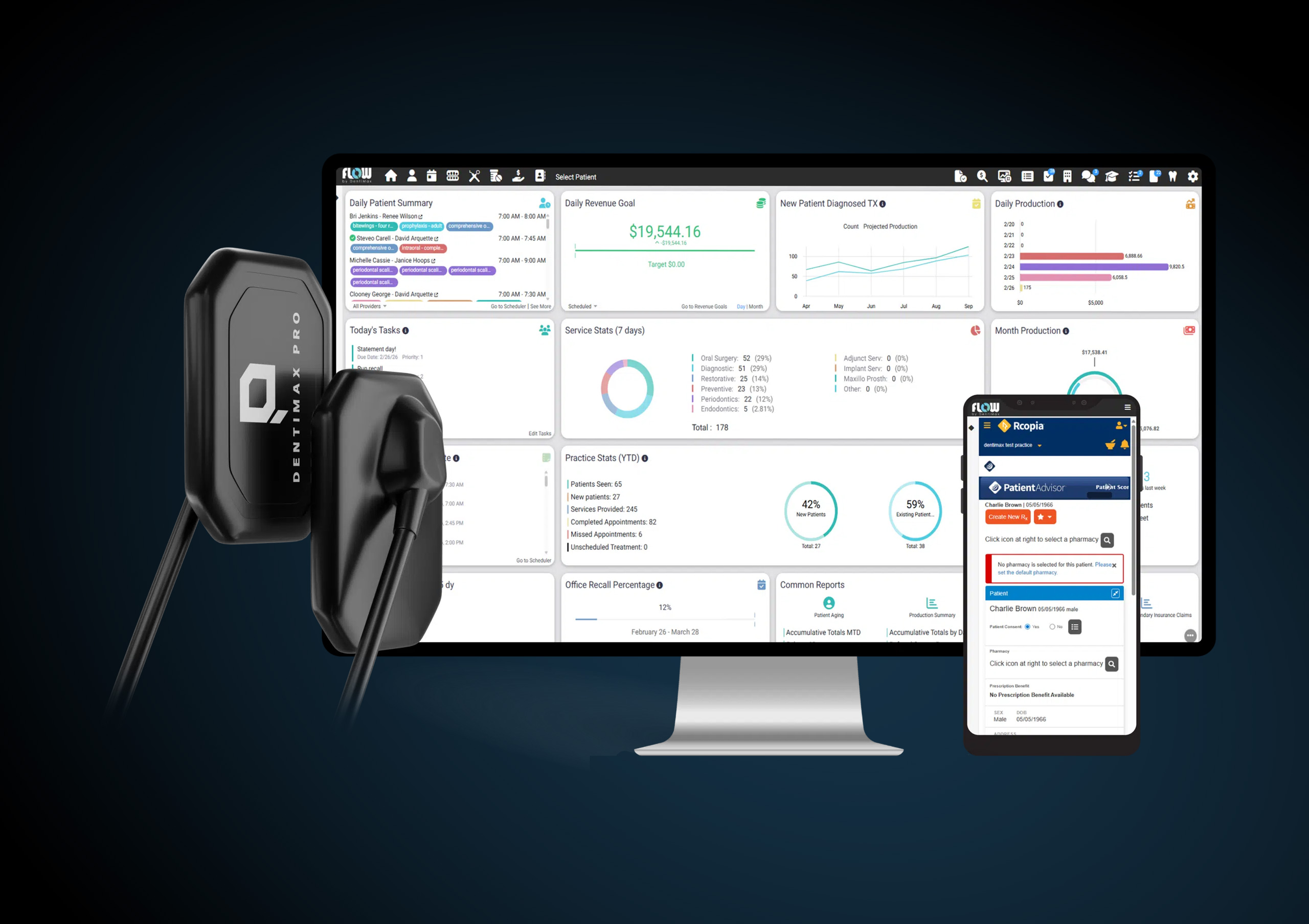


Interview with DentiMax Co-Founder David on Flow, the Easy-to-Use Dental Practice Management Platform: Consolidation Made Simple
We recently sat down with David, co-founder of DentiMax, the company behind Flow, the top-rated dental practice management platform known for its ease of use. As operational software stacks grow more crowded across nearly every industry, David explains how business leaders should think about consolidation: where it creates value, where it creates risk, and why the core platform still has to reflect the specialized workflows of the industry it serves.
Q: Software consolidation is a hot topic right now, but it means different things to different people. Where do you draw the line between functions that should live within the core platform and specialized tools that are better handled through integrations?
David: For us, the line is whether a function is part of the daily operational flow or a specialized capability that only needs to plug in occasionally. Scheduling, patient communication, reporting, and the day-to-day administrative work of running a practice have to live in the core platform because they touch every other part of the business constantly. If a practice has to leave its main system to check the schedule, message a patient, or pull a production report, that’s friction multiplying all day long.
On the other hand, certain functions, such as imaging systems or niche compliance tools, can sit outside the core platform and connect into it. A lot of software companies make the mistake of trying to own everything, including things a dedicated specialist can handle better. Practices make the opposite mistake: they let every function become its own disconnected tool until nothing talks to anything else.
Q: Dental practices manage clinical records, imaging, scheduling, insurance, billing, and patient communication. What does that complexity reveal about the limitations of generic business software?
David: It reveals that generic software is built around a generic workflow, and dental practices don’t have one. Insurance verification is a good example: it isn’t a simple line item; it’s a process with its own logic, timing, and dependencies that touches scheduling and billing at the same time. A generic scheduling tool or a generic CRM has no concept of that. So practices bolt on point solutions to cover the gaps, and now they have five or six systems that each do one thing reasonably well but don’t share information with each other.
That’s the trap. It looks like flexibility, but it’s actually fragmentation. Someone on the team ends up as the manual connector between systems, re-entering the same information, checking multiple places to understand what’s actually happening with a patient or a claim. That’s not a technology problem so much as a design problem. The software wasn’t built around how the work actually happens.
Q: How has DentiMax approached connecting those workflows without sacrificing the specialized functionality dental practices require?
David: We built Flow around the idea that scheduling, reporting, insurance checks, and patient communication aren’t separate products. They’re one workflow viewed from different angles. So instead of a calendar that happens to sit next to a reporting tool, the schedule is directly connected to production and collections data, and both are connected to how the practice communicates with patients. When something changes in one place, it shows up everywhere else automatically.
At the same time, we didn’t try to force every specialized need into a one-size-fits-all mold. Flow supports single practices, mobile dental units, DSOs, and multi-location groups, and each of those has genuinely different operational needs. So the platform has to be flexible enough to reflect those differences while keeping the core workflow unified. That balance, one connected system that still respects how different practices actually operate, is the hard part. It’s also the part that matters most.
Q: What signs tell a practice leader that their current stack has become more of a liability than a convenience?
David: The clearest sign is when your team spends more time managing the software than the software saves them. If staff is toggling between systems to answer a basic question, manually reconciling numbers that should already match, or if leadership can’t get a real-time answer about production or collections without someone compiling a report by hand. That’s a stack working against the business, not for it.
Another sign, especially for multi-location practices, is when leadership loses visibility. If you can’t see what’s happening across your locations without logging into separate, disconnected systems for each one, you’re not managing the business in real time. You’re reconstructing it after the fact.
Q: As AI becomes embedded into business software, do you expect consolidation to become more important?
David: I think it becomes essential. AI is only as useful as the data it can see, and if that data is scattered across six disconnected tools, AI can’t do much with it. The value of AI in a practice — flagging scheduling gaps, surfacing collections trends, predicting where insurance issues are likely to slow things down — depends entirely on having a connected view of scheduling, billing, insurance, and patient communication in one place.
So consolidation isn’t just an efficient play anymore. It’s becoming the prerequisite for getting real value out of AI at all. Practices still running a fragmented stack will find that AI features layered on top of that fragmentation don’t deliver much, because the underlying data was never unified to begin with.
Q: What advice would you give an operations leader in a different industry, say, field service, who’s evaluating whether to consolidate onto a single platform?
David: Start by mapping where your team actually loses time today, not where you assume the problem is. In our world, it’s usually insurance checks, scheduling changes, and patient follow-up. In field service, it’s probably dispatching, job documentation, and customer updates. Wherever your team is doing manual reconciliation between systems, that’s your consolidation priority.
Then be honest about which of your tools are truly specialized and which ones exist because your core system never handled that function well in the first place. Consolidating doesn’t mean choosing a single tool that claims to do everything. It means choosing a core platform that reflects how your industry actually works, and being selective about what stays separate. Done well, the result isn’t just fewer logins. It’s a team that spends its time on the work itself instead of managing the tools around it.
To learn more about how DentiMax’s Flow platform helps dental practices consolidate scheduling, reporting, insurance checks, and patient communication into one connected workflow, visit dentimax.com.