

You’re on a 9/12 pitch in July, trying to photograph hail strikes while your phone keeps sliding on the slope. Back at the truck, you’ll reconstruct the damage report from memory and hope it holds up with the adjuster.
AI roofing inspections are changing how crews capture, document, and act on field data. This article covers four areas where the technology makes a measurable difference: safety, documentation quality, inspection consistency, and operational speed.
AI Roofing Inspection Benefits at a Glance
| Benefit | What Changes for Your Crew | What Changes for Your Office | Roofing-Specific Impact |
|---|---|---|---|
| Safety | Fewer repositioning trips on steep or damaged sections; hands-free capture on-site | Less reliance on incomplete verbal reports after the fact | Storm surge inspections, steep-pitch hazard zones, post-hail assessments |
| Documentation Quality | Voice narration and photos captured together in real time | Structured job records generated automatically without follow-up calls | Insurance supplement preparation, adjuster claim documentation |
| Consistency | Same checklist items are covered on every visit, regardless of which crew | Fewer callbacks asking crews to clarify what they saw on-site | Multi-crew operations across storm-hit neighborhoods during peak season |
| Operational Speed | Fewer manual steps between inspection notes and estimating | Estimates built directly from structured field data | Material quantity accuracy, faster proposal-to-signature cycle |
Safety: Fewer Minutes in the High-Risk Zones
Falls remain the leading cause of construction fatalities in the U.S., and roofing accounts for a disproportionate share of those fatalities. Every unnecessary repositioning trip to photograph a different angle, every extra minute balancing on a damaged section to type a note, adds exposure time that doesn’t need to be there.
The Colorado Roofing Association reports that drones are used on 55% of roofing projects for inspections and measurements. The National Roofing Contractors Association reports that 85% of contractors expect AI to reduce time spent on repetitive tasks. EagleView reports 98.77% accuracy for roof measurements against independent benchmark measurements. These figures show why contractors are testing aerial capture, computer vision, and AI-assisted documentation as part of safer inspection workflows.
For hands-on inspections on occupied residential properties, where drones aren’t always practical, AI voice and photo narration tools reduce the same exposure differently. An inspector who narrates damage verbally while scanning a section covers more ground per minute and spends less cumulative time in high-risk positions. Both approaches share the same goal: reducing how long your crew has to be on the roof to produce a complete record.
How AI Roofing Inspections Improve Documentation Quality
When a crew member climbs down after a storm assessment, they carry a mental picture of what they saw. Some of it makes it into the report. Weather, urgency, and the next job on the schedule take the rest.
Documentation gaps come from format:
- A voice memo doesn’t connect to a job file
- A photo taken on a personal phone doesn’t sync to your CRM
- Notes typed from memory two hours later miss details that felt obvious on the roof
Adjusters push back, supplements get delayed, and someone has to go back up.
Zuper’s AI Voice Notes handle dictation in job notes, checklist fields, and inspection forms. AI Take and Talk captures a photo and a spoken description, then transcribes the description and tags it to the image. AI Walkthrough Note records video, photos, and audio during a job, then combines the captured media with a transcription and summary in the job note.
For a field inspector, the workflow looks like this:
- Use AI Voice Notes to dictate observations into a job note, checklist field, or inspection form.
- Use AI Take and Talk when each photo needs its own spoken description.
- Use AI Walkthrough Note when a site visit needs multiple photos, audio, or video combined into a summarized job note.
For insurance restoration work, a Zuper job record can bring together photos, transcribed narration, an AI Walkthrough Summary, and a timestamped job timeline for review. The record gives your estimator and office team a clearer source of information when they prepare supplement documentation or respond to adjuster questions.
Inspection Consistency: Every Crew, Every Visit
Talk to any production manager running multiple crews during hail season, and you’ll hear some version of the same problem: two inspectors assess similar storm damage and produce reports that look nothing alike. One delivers 45 photos organized by slope, a written breakdown by section, and a material quantity estimate. The other sends 12 photos and a note that says “significant hail damage, recommend full replacement.” The two reports may both close the visit, but only one gives the estimator a clear record for the next step.
Freeform documentation reflects whoever was holding the phone. When AI tools guide inspection through structured checklists and capture narration in real time, the output follows the same format on every visit because the tool shapes what gets recorded, not individual habits.
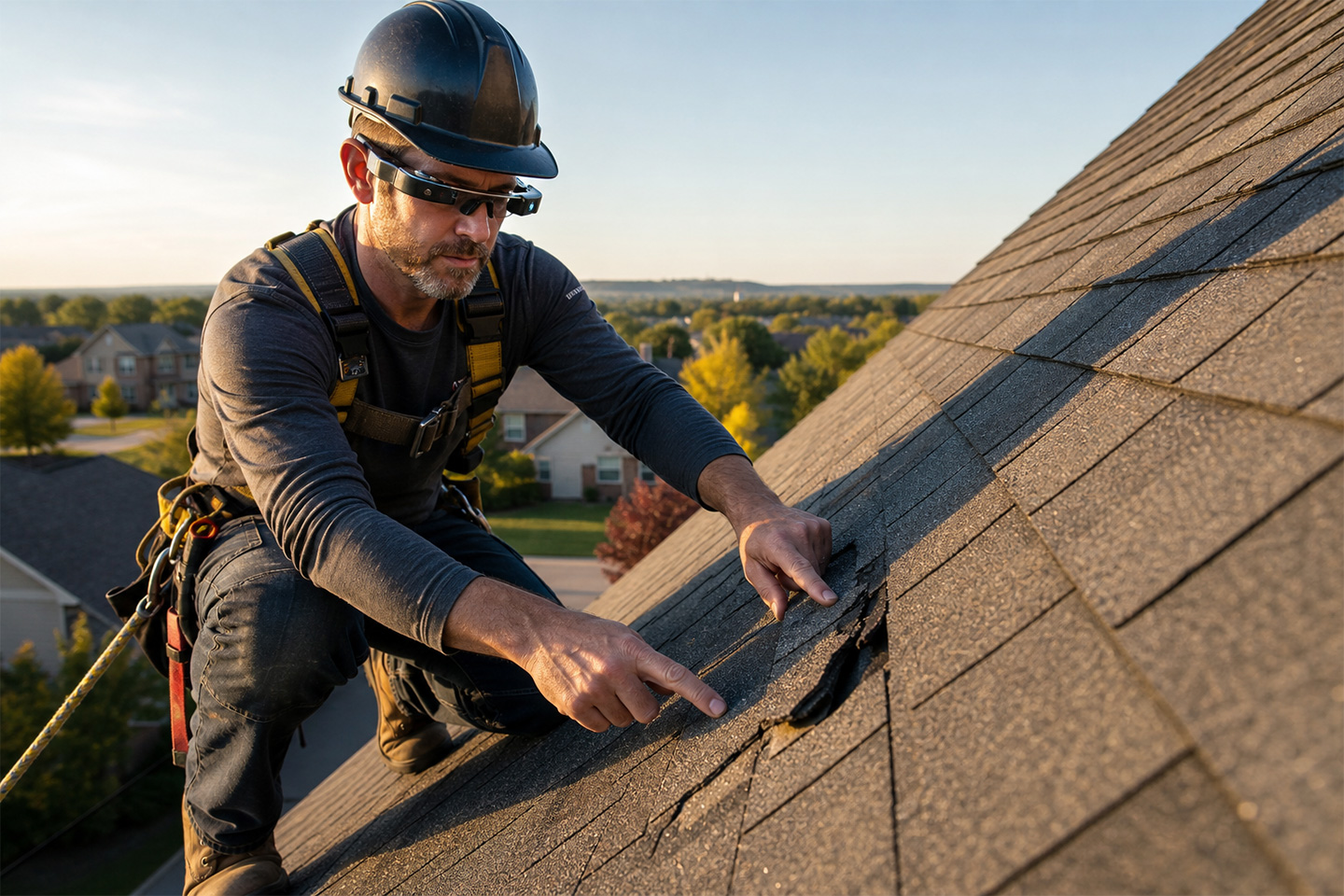
With Zuper Glass, the wearable AI system built specifically for field trades, inspectors capture what they see and say hands-free while the platform organizes content into structured job documentation. The same photo categories get covered. The same checklist fields get completed. A production manager reviewing five jobs from five different crews sees five records that are actually comparable.
That consistency compounds over time. Standardized records let you compare damage severity by neighborhood, supplement timelines by adjuster, and material quantities by storm type across your own jobs.
Operational Speed: From Inspection to the Next Step
The inspection rarely stops a job from moving forward. What stalls the timeline is everything that happens after the inspector climbs down.
Your inspector finishes a storm damage assessment at 3 PM. The photos are on their phone. The notes are in a text thread. The adjuster meeting is on Thursday. Someone has to organize the documentation, build the estimate from the inspection data, route the job to production, and brief the crew on access, scope, and materials. If all of that is done manually, the homeowner will have already talked to two other contractors by the time your proposal arrives.
AI-native field service tools connect inspection output to the next step. When your inspector completes an AI Walkthrough Note in Zuper:
- The AI Job Summary provides a structured view of job details, including category, status, assignment, parts, tasks, and timeline. Your estimator can review that summary before building a quote.
- Photos, transcribed narration, and walkthrough summaries remain available in the job record for office review.
- Your office can configure job reminders, delay alerts, and status alerts through Zuper’s notification tools.
- Your crew can access job details, access codes, and scope details from the mobile app before arrival.
Zuper’s roofing workflow connects inspections to proposals, material requests, installation jobs, service tasks, and invoices on a single platform. The estimator reviews the job record and uses the appropriate measurement and pricing tools to prepare the proposal. Zuper documents measurement integrations with EagleView, Hover, GAF Quick Measure, and RoofScope, giving roofing teams specific ways to connect measurement data with estimating workflows.
Maven Roofing, a veteran-owned company that runs Zuper across its full operation, saved 8 hours per person per week and shortened new-hire ramp-up by 40% after consolidating its tech stack into one platform. For a deeper look at how the full job lifecycle connects, the AI Operating System for Roofing covers it in detail.
Contractors who close fastest are the ones whose inspection-to-production pipeline requires the fewest manual handoffs.
What Better Inspections Do for Your Business
AI roofing inspections reduce time on hazardous surfaces, produce documentation that adjusters can actually use, and connect field data directly to estimates, scheduling, and dispatch without manual re-entry.
That’s what Zuper’s AI roofing platform is built to do: fewer handoffs between what your crew captures on the roof and what your office needs to move the job forward.
See how Zuper’s AI inspection and workflow tools work in your operation. Book a demo.